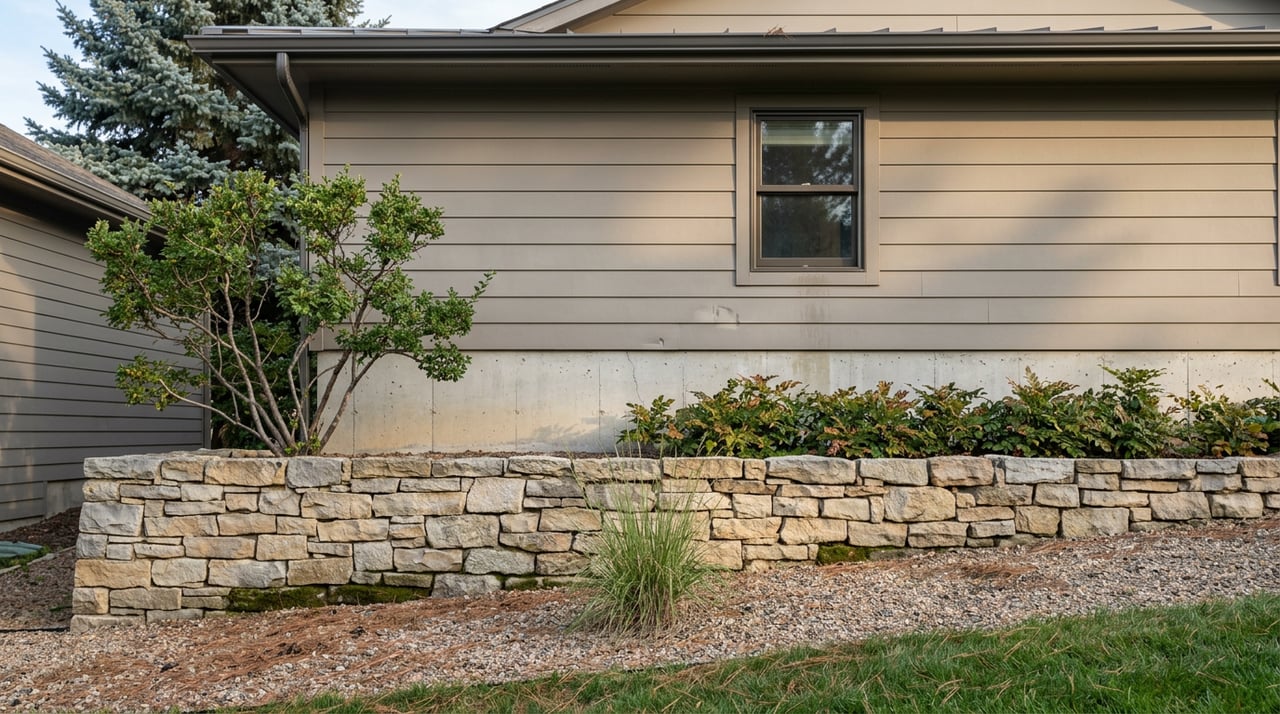
Ask any Front Range agent about foundations and you'll hear some version of the same line: expansive clay is just the cost of doing business here. A Colorado Association of Realtors economist has said as much publicly, noting he hasn't seen it treated as a major cost factor along the Front Range and that it typically isn't a consideration when a home gets priced for market. That's true as far as it goes. Bentonite clay sits under most of the Front Range, and treating every closing as a crisis over soil that's older than Golden itself would be exhausting for everyone.
But that line does something else too. It flattens a real difference between two houses in Golden that both happen to sit on the same clay, built forty years apart, with completely different paper trails behind them. If you're under contract on a Golden home right now, the question that actually matters isn't whether the soil moves. It's whether anyone has ever written down what happened when it did, and whether you have a legal right to see that document.
Two very different paper trails
Colorado does require a disclosure related to swelling soils, but it applies unevenly. Under state law, builders and developers of new construction have to hand buyers a summary soils report at least 14 days before closing, satisfied in practice by a Colorado Geological Survey publication called SP-43, "A Guide to Swelling Soils for Colorado Homebuyers and Homeowners." That report walks through the geology, the construction implications, and a homeowner checklist, and it's mandatory for the builder to provide it.
Resale homes work differently. There's no statute forcing a seller of an existing house to produce a soils report, because nobody built it under that requirement in the first place. What resale buyers get instead is a common law duty: Colorado courts have held that sellers must disclose latent defects they actually know about. That's a real protection, but it only reaches what the seller knows. If nobody ever tested the soil, ran a geotech report, or had an engineer document a repair, there's nothing to disclose because there's nothing on paper.
That gap is the actual risk in a Golden transaction. Not the clay. The absence of a document proving what the clay has already done to a specific house.
Golden's housing stock isn't one story
Golden's neighborhoods break into a few distinct construction eras, and each one carries a different likelihood that a paper trail exists at all.
| Where | Typical era | What local inspectors flag | Paper trail you should expect |
|---|---|---|---|
| Downtown Golden | Mixed vintage, oldest homes pre-1978 | Lead paint in the pre-1978 stock, negative grading around the foundation from decades of erosion | Little to none guaranteed. Ask directly for any past engineering letters. |
| Lakota Hills and Golden Ridge, south of West 6th Avenue | Mixed vintage, majority 1990s-2000s, HOA-governed | The older homes mixed into this area can still carry clay or cast-iron sewer laterals and dated electrical wiring, even though the majority-newer stock sees fewer issues | Somewhat more likely to exist for the newer subdivision-era homes. Ask which decade your specific house falls into. |
| Golden's northern-most section, the hillside neighborhoods near North Table Mountain and the Mt Galbraith Loop Trail | Mostly 1960s-1970s | Galvanized supply piping flagged as the top plumbing concern; foothill grade shifts can also affect buried sewer and utility lines | Rare unless a prior owner did a repair and kept the invoice. Push for a sewer scope. |
None of this means the newer subdivisions are risk-free or the older neighborhoods are traps. It means the odds of walking into your due diligence period with an actual document in hand shift by era, and the negotiating leverage that document gives you shifts with it. A structural engineer's letter that already exists costs you nothing to request. One that doesn't exist costs you a few hundred dollars and about a week to commission, and by then you're negotiating from a weaker position because the clock on your inspection objection deadline is already running.
What a foundation problem actually costs if you skip this
The Colorado Geological Survey has tracked expansive soil damage nationally for decades and found it inflicts more than twice the annual damage of floods, hurricanes, tornadoes, and earthquakes combined, a comparison that holds because the same clay minerals, largely montmorillonite, can exert pressures of 20,000 pounds per square foot or more against a foundation once wetted. Golden sits squarely inside the geology that makes this a Front Range problem rather than an abstract national one.
As of May 2026, foundation damage repair costs in the Denver metro area have run from roughly $8,000 to $35,000 depending on severity, with some full pier or shoring jobs exceeding $60,000, according to a Denver-area engineering firm's client-facing estimate. A standalone structural engineer's evaluation, the kind that gives you a stamped letter rather than a contractor's guess, tends to run a few hundred dollars elsewhere along the Front Range. Compared to the repair numbers, that's a rounding error. It's also the only way to convert "the soil here moves" from a rumor into a document you can use at the negotiating table.
What to actually ask for during your inspection window
If you're in contract on a Golden home, this is the short list worth working through before your objection deadline closes:
- Ask the seller directly whether a soils report, geotechnical study, or structural engineer's letter exists for the property, even if it's old.
- If the home is in Golden's older hillside stock or is an older holdout within Lakota Hills or Golden Ridge, request a sewer scope specifically. Clay and cast-iron laterals from those eras are a known local vulnerability, separate from the foundation question entirely.
- If nothing exists, commission your own structural evaluation during the inspection period rather than after closing. A report generated after you own the house has no negotiating value.
- Check exterior grading yourself before you even schedule an inspector. Years of erosion can leave a slope tilting back toward the foundation instead of away from it, and that's visible without any special equipment.
- For homes in Jefferson County, property records searchable through the county assessor can confirm the build year, which tells you which era's typical issues to expect before you've even walked the property.
Quick answers for Golden buyers
Does every home in Golden sit on expansive soil? Most of the Front Range does, including Golden, since the clay minerals responsible are widespread in the region's geology. That doesn't mean every home has been damaged by it. It means the construction and maintenance history matters more than the address.
If my seller marks "unknown" on the disclosure form, are they hiding something? Not necessarily. The common law duty only covers what a seller actually knows. If no engineer ever tested the property, "unknown" can be an honest answer rather than an evasive one. That's exactly why requesting the paper trail yourself, rather than relying on the disclosure form alone, matters more in older Golden neighborhoods than in newer platted subdivisions.
Is a foundation crack automatically a deal-breaker? No. Hairline cracks are common and often cosmetic. Inspectors pay closer attention to cracks that are horizontal, wider than about an eighth of an inch, or forming a stair-step pattern in block or brick, since those patterns tend to indicate differential settlement rather than normal curing.
Does a newer home in Lakota Hills or Golden Ridge mean I can skip a structural evaluation? No, though the odds of a documented soils report existing are generally better for that era of subdivision construction. Ask for it before assuming it exists.
Buying in Golden means buying into a real geology, not a rumor about one. The clay isn't going anywhere, and it doesn't need to scare you off a house you love. It does deserve a specific question during your inspection period: not "is this normal for Colorado," but "what does the paperwork on this particular house actually say." If you're working through a Golden purchase and want a second set of eyes on what to ask for before your objection deadline closes, Laura Gilsdorf is happy to walk through it with you. Let's Connect.